Impact Investment
Under our sustainable investment framework, we define impact investing as investments that are primarily aimed at generating financial returns while intentionally bringing about measurable behavioural changes in investee companies through investment actions—such as investment decisions and stewardship activities—in order to achieve positive sustainability outcomes. To put this into practice, investors are required to clearly articulate their intent in terms of which environmental and social challenges they seek to address, to make a contribution to resolving such challenges through investee companies, and to measure the environmental and social impacts generated through these investments.
Utilization of the Materiality Map in Impact Investing
In impact investing, accurately identifying environmental and social issues and understanding the solutions to address them are essential. By integrating our proprietary materiality map with our impact investment framework, we aim to maximize both investment returns and positive environmental and social impact through a seamless process—from theme identification and security selection to engagement and impact assessment.
In establishing our impact investment approach, we utilize the following three focus areas identified through our materiality map.
- Climate change
- Biodiversity and environmental destruction
- Human rights and health & wellbeing
In addition, we have defined “Declining Birthrate, Aging Population, and Regional Revitalization,” a social issue unique to Japan, as an impact theme. In line with these themes, we analyze how corporate business activities can contribute to addressing environmental and social challenges.
Focus Areas and Japan-Specific Issues
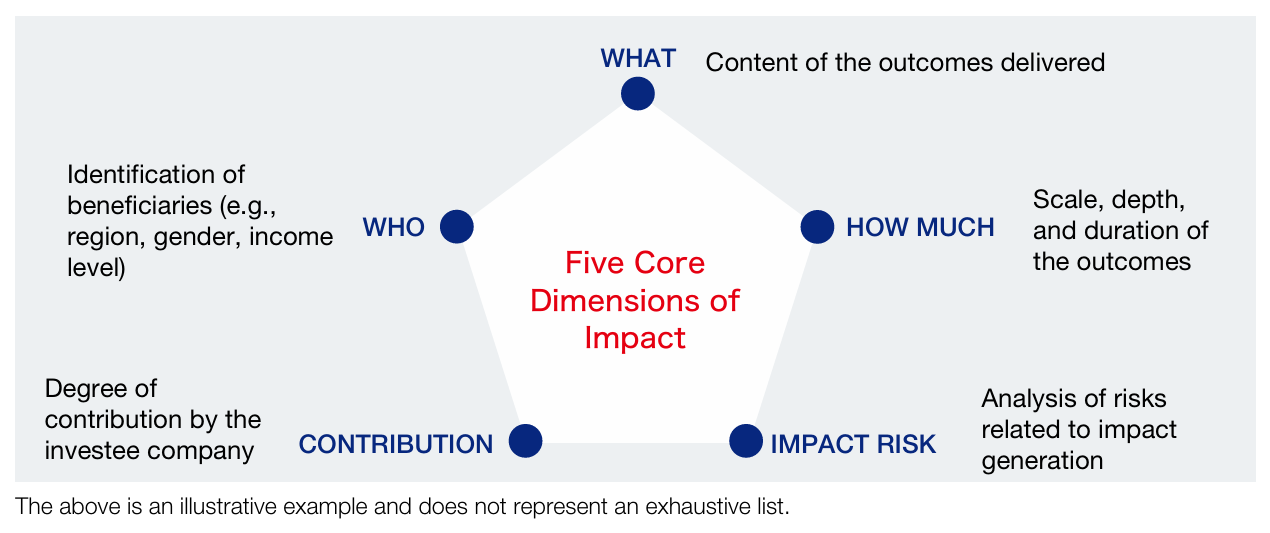
In our security selection process, we assess whether a company’s business activities align with our impact themes based on internally developed Impact Business Evaluation Criteria. These criteria are linked to each item in the materiality map, and analysis is conducted from the following perspectives.
- The explanation of Materiality (The backgrounds and scale of issues)
- The causes and solutions (Scientific evidence and policy trends)
- The products and services that can contribute to problem-solving
For example, with respect to climate change (transportation), we evaluate businesses that contribute to reducing GHG emissions—such as electric vehicles (EVs) and modal shifts to rail—based on the fact that the transportation sector accounted for approximately 23% of global CO2 emissions as of 2019*. The evaluation involves quantifying impact by comparing performance against a benchmark (gasoline vehicles). We establish such evaluation items for each materiality topic and calculate an Impact Business Score. Only securities that exceed a certain score threshold are included in the portfolio. Following investment, we promote impact enhancement through engagement with investee companies. Specifically, we seek to clarify the social value of their businesses, encourage disclosure of impact indicators, and confirm progress in addressing material issues, with the aim of contributing to improve corporate sustainability. Through research and analysis grounded in our materiality map, this strategy ensures the transparency and consistency of our impact investment approach. Looking ahead, we will continue to refine our evaluation criteria and further advance our impact measurement methodologies.
- Source: IPCC AR6 WG3 Chapter10
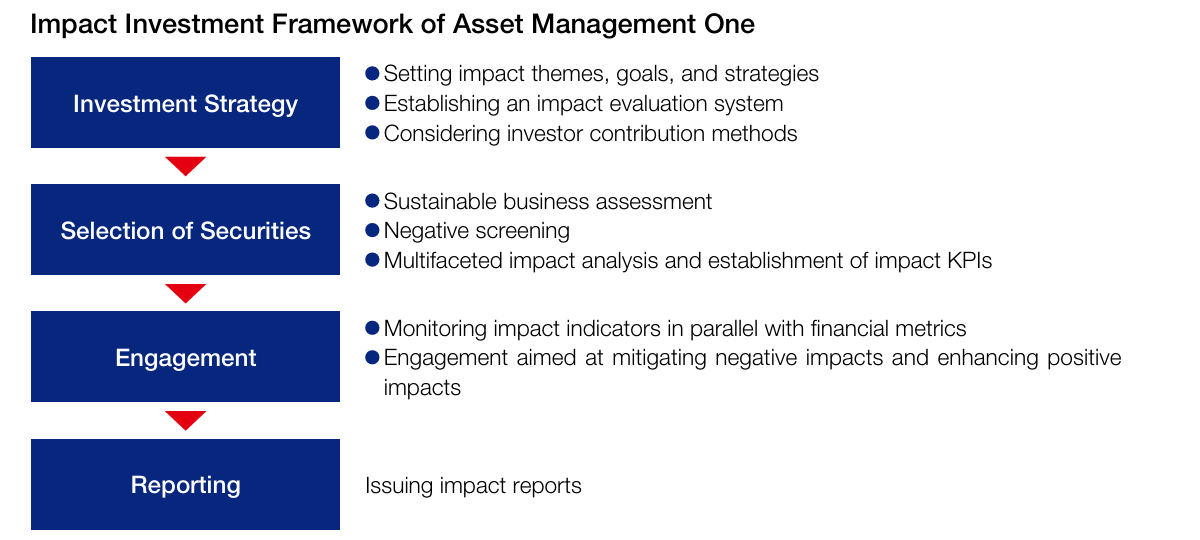
Impact Investment Framework
At Asset Management One, we have established an Impact Investment Framework for the formulation and implementation of our impact investment strategies, with the primary objective of setting targets for, and evaluating and reporting on, the “positive and measurable environmental and social impact” that characterises impact investing .
“Environmental and social impact” refers to the environmental and social effects generated as a result of business activities or the provision of products and services. With the intention of creating positive impact and mitigating negative impact through investee companies, and with reference to domestic and international guidelines, we incorporate impact considerations at each stage of the investment process, as illustrated below: investment strategy, security selection, engagement, and reporting.