Governance of Sustainability
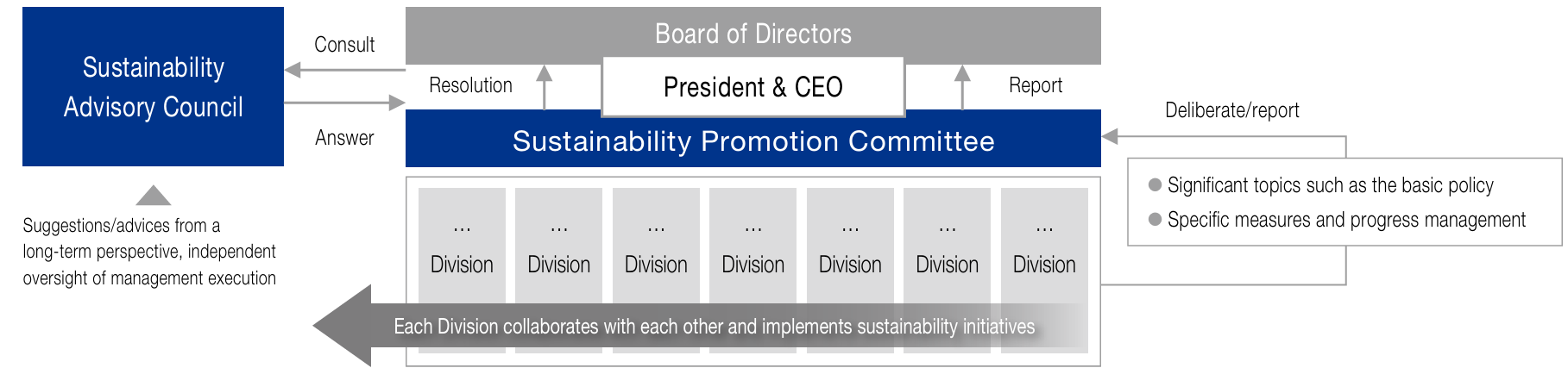
We believe that it is necessary to implement sustainability into our management in order to “Create a Sustainable Future through the Power of Investment”, and we have defined “Sustainability Governance” as “a system in which sustainability is incorporated into management decision-making and overseen by the Board of Directors”. We have established a “Sustainability Promotion Committee” at the executive level and a “Sustainability Advisory Council” at the supervisory level, which is an advisory body to the Board of Directors, and have built a framework around them.
When there are potential conflicts of interest at investee companies with the parent company, etc., we have systems for making appropriate voting decisions. For the most important company proposals from the standpoint of conflicts of interest, involving the parent company, for example, appropriate voting decisions are made after requesting/receiving the recommendations of a third-party proxy adviser (ISS), in accordance with our firm’s guidelines, consulting with the Proxy Voting Advisory Council, which is majority composed of independent outside directors and conducting deliberations through the Stewardship Promotion Committee. Monitoring is conducted by reporting the results of voting to the Board of Directors.
Sustainability Advisory Council
In July 2021, the Board of Directors established the Sustainability Advisory Council as an advisory body, and invited two external advisors with deep knowledge of the field of sustainability to join the council. The Board of Directors regularly receives reports and discusses the basic policy and implementation status of our sustainability initiatives, and when necessary, refers important agenda items to the Sustainability Advisory Council for advice from external advisors from a long-term perspective, which we use to improve the quality of our sustainability initiatives.
Sustainability Promotion Committee
In order to implement important strategies related to sustainability, we established the Sustainability Promotion Committee in April 2024 with the aim of improving the execution capabilities of the executive team and enhancing governance. We are discussing and examining our approaches to sustainability promotion from two perspectives: as an asset management company and as a business company.
Governance of Our Stewardship Activities
Since its establishment in October 2016 our firm has had a dedicated department for stewardship activities and has been committed to maintaining management systems for engagement activities and the exercise of voting rights. The Stewardship Promotion Committee, established as a management policy committee, oversees all stewardship activities, including the exercise of voting rights, as well as the appropriate management of conflicts of interest. The committee, which is chaired by the Chief Investment Officer and whose members include the Head of the Risk Management Division, conducts deliberations within the investment management division, independently of other corporate functions, and thereby promotes stewardship activities. Members of the Audit and Supervisory Committee attend meetings of the committee as part of an appropriate system of controls. The Stewardship Promotion Committee deliberates on the most important proposals from conflicts of interest standpoint and on the establishment, amendment, and abolishment of the Proxy Voting Guidelines, and it also deliberates and reports on matters related to overall stewardship activities, including evaluations and reviews for the execution of stewardship responsibilities and dialogue (engagement) with investee companies.
Our firm undertakes a self-evaluation for each principle and guidance in the Stewardship Code for each fiscal year. The details of stewardship-related activities and the self-evaluation are deliberated by the “Stewardship Promotion Committee,” confirmed as appropriate, and reported to the Board of Directors, which is composed of nine directors including three independent outside directors.
Management system for conflict of interest
When there are potential conflicts of interest at investee companies with the parent company, etc., we have systems for making appropriate voting decisions. For the most important company proposals from the standpoint of conflicts of interest, involving the parent company, for example, appropriate voting decisions are made after requesting/receiving the recommendations of a third-party proxy adviser (ISS), in accordance with our firm’s guidelines, consulting with the Proxy Voting Advisory Council, of which independent outside directors make up a majority, and conducting deliberations through the Stewardship Promotion Committee. Monitoring is conducted by reporting the results of voting to the Board of Directors.
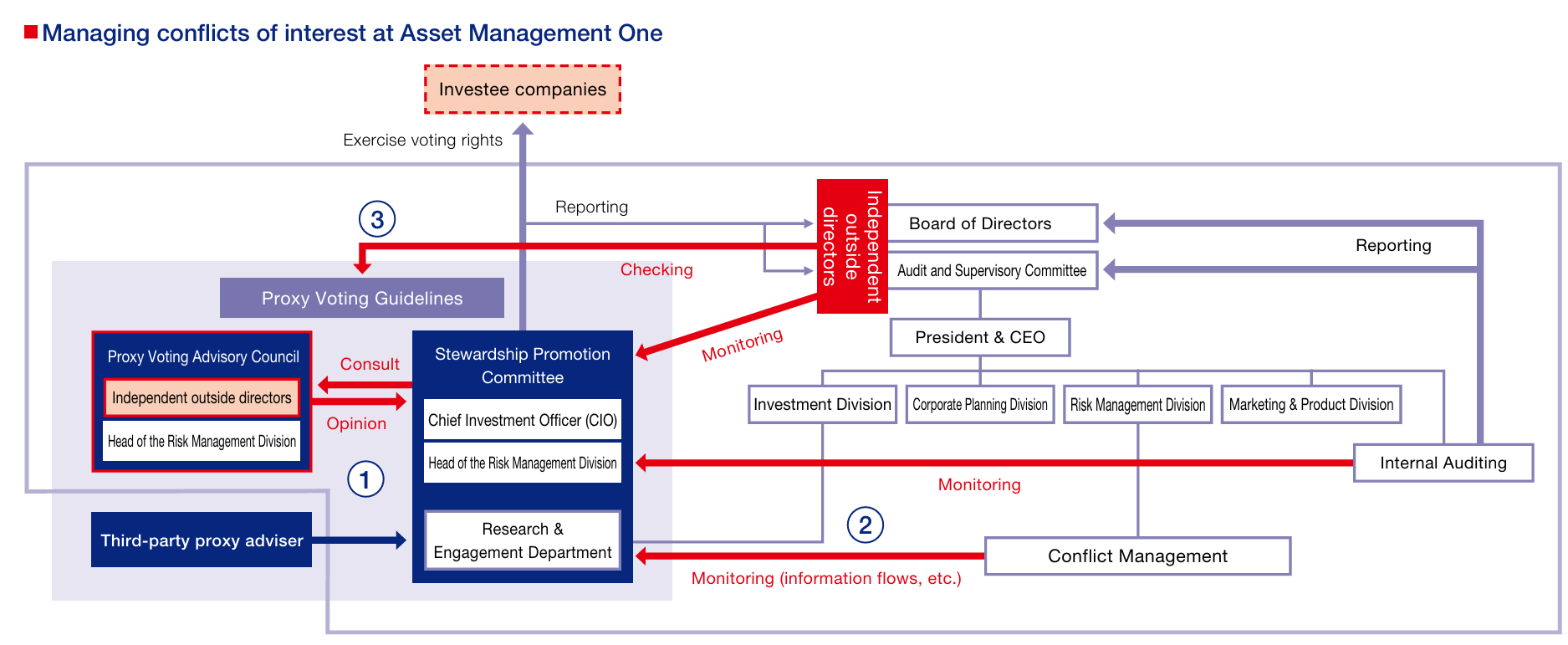
- Regarding proxy agendas that involve potential conflicts within the parent or group companies, our firm utilizes a third-party proxy adviser’s recommendations. After seeking independent opinions of the Proxy Voting Advisory Council (of which the majority are independent outside directors), Stewardship Promotion Committee discusses thoroughly before any voting decisions are made.
- One of the effective measures that Asset Management One has adopted for managing conflicts of interest is to isolate information flows, with regards to proxy voting matters, between the persons in charge of exercising voting rights and other employees. We set up rules and closely monitor the information flows.
- Asset Management One publishes its Proxy Voting Guidelines including the Voting Criteria and executing proxy voting in accordance with them at shareholder meetings. The Guideline is reviewed annually. The revisions are examined at the Stewardship Promotion Committee and then reported to the Audit and Supervisory Committee (with the majority of independent directors).
Risk Management to Support Value Creation
In recent years, with growing uncertainties, the number and type of risks have also significantly increased. Our firm sees risk management as an important cornerstone in supporting the achievement of sustainable value creation by our firm as a long-term investor. We have been continuously strengthening risk management frameworks accordingly.
Risk management framework
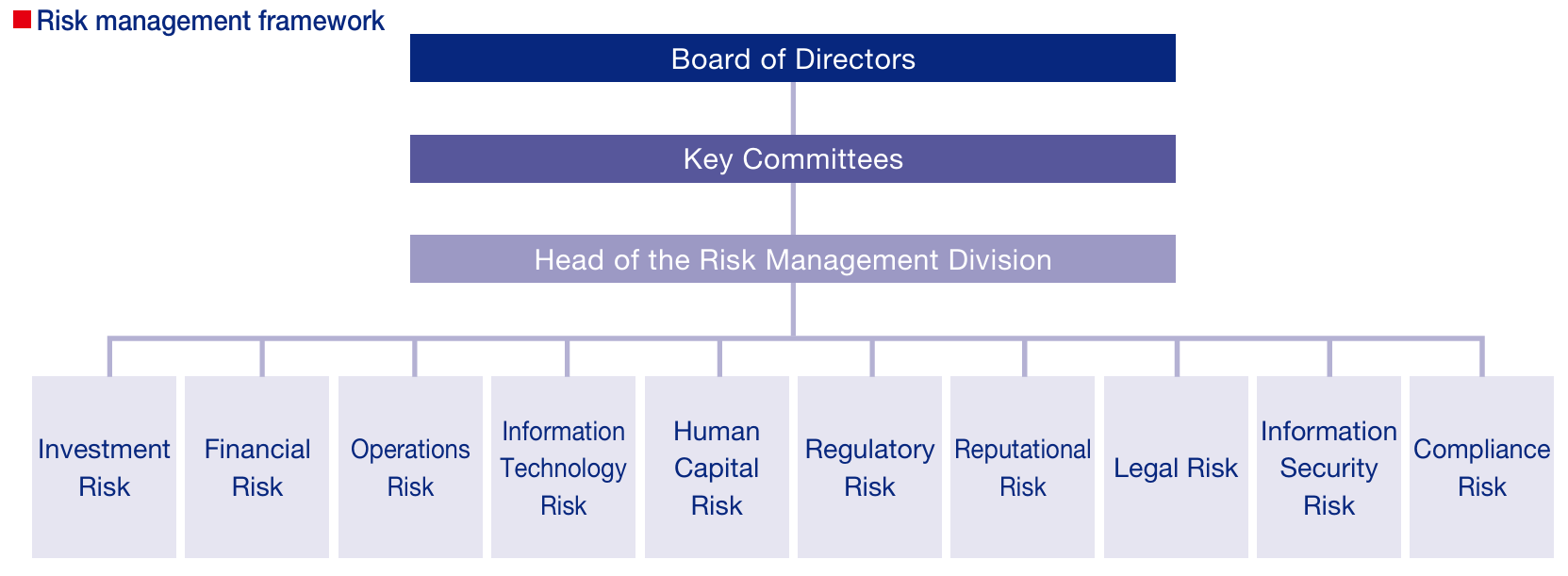
Our firm is committed to strengthening risk management in accordance with its basic policy established by the Board of Directors. This includes continuous efforts to enhance risk management practices through utilizing a variety of methods. Our firm has established a number of committees to monitor and report on the implementation and status of risk management practices across our firm. Among the risks pertaining to our firm’s businesses, our firm has classified relevant risks into a number of categories including: investment risk related to entrusted assets; financial risk such as market risk and credit risk; and operational risk such as information technology risk, operations risk, legal risk, and regulatory risk etc. Mitigating and managing each type of potential risks is also conducted based on the specific characteristics of the risk. For each of these risk categories, a specified department and team has been assigned to take responsibilities for planning, formulating and promoting measures to manage respective risks, and also reporting to the committees on the status of risk management and related matters.
Along with the risk management approach by category, we have also established a comprehensive risk management framework and approaches that enable us to identify and assess overall risks holistically and keep the risk within a manageable and acceptable level for business operations. In addition, our firm defined material risk as those with a potential to have significant effects on our firm’s business and management strategy. The Risk Management Committee is closely monitoring the status of controls over such material risks. In identifying material risks, active and thorough discussions are held at the Risk Management Committee based on the risk assessment criteria including risk cause analysis as well as risk scores calculated from the likelihood of risk materializing and the degree of impact if it does materialize. The insights and assessment from these discussions are used for common recognition of relevant risks and also for forward looking risk management.
Risk management approaches for sustainability
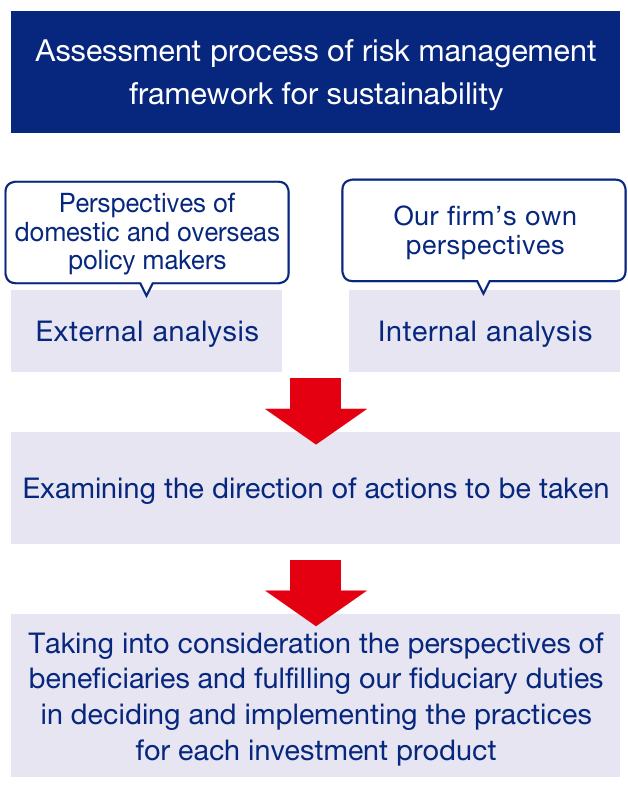
When developing the risk management approaches for sustainability, Risk Management Division also analyses and evaluates the actions taken in risk management practices relating to sustainable investment, and monitors the investment process of sustainable investment products. In addition, the Risk Management Division has started initiatives to further enhance the risk management framework and approaches to sustainability, including adding new ESG related criteria in due diligence of external investment managers, and conducting secondary examination for due diligence of the providers of ESG information and scores.